o
o
g
l
e
★★★★★
5.0 (64 Reviews)
Google Guaranteed
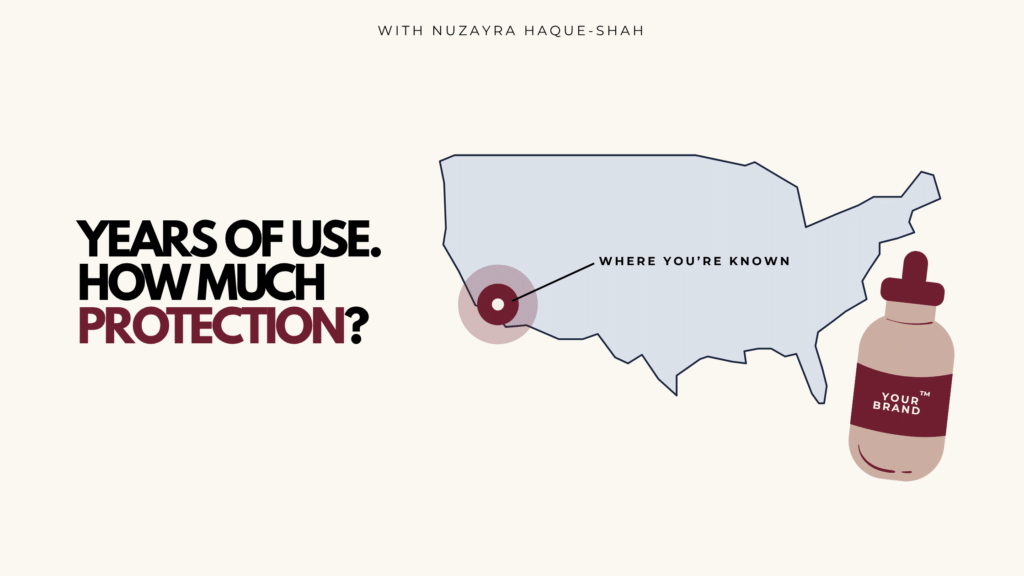
What happens if I have been using my brand name for years without registering it?
Nationwide brand protection for ambitious founders, direct-to-consumer innovators, and growing enterprises. Led directly by attorney Nuzayra Haque-Shah.
You still have rights, but they’re narrower than most founders think. Years of use give you “common-law” trademark rights, but only in the places where customers actually know you. You don’t get nationwide protection, a legal presumption that you own the name, or the strongest federal tools. And someone else can register the name and lock you into your current footprint. The fix is to file a federal application now.
Why this Matters
Unregistered brands usually find out where they stand at the worst possible moment: right when they’re ready to grow.
Picture this. You’ve sold skincare under the same name in Southern California for six years. You land a national retail deal and start selling online everywhere. Then you learn a company in another state filed a federal application for a similar name two years ago.
You probably keep the right to use your name at home. But that company may be able to stop your expansion into the rest of the country, and use its registration to report your listings on marketplaces. Six years of brand-building, capped at the map you had the day they filed.
What rights do I get from using my brand name without registering it?
Common-law trademark rights. They come from actually using the name to sell goods or services, not from forming an LLC, buying a domain, or posting on Instagram. Once customers associate the name with you, you can stop a later user from causing confusion in your market.
The catch is geography. Common-law rights generally cover the area where you’ve built real market presence, and some courts add a “zone of natural expansion” around it. Selling online doesn’t automatically make that area nationwide. Courts look at where your customers actually are and how much you sell there.
You can still sue in federal court over an unregistered mark, under Section 43(a) of the Lanham Act (15 U.S.C. § 1125(a)). But you carry the full burden of proving you own the mark, that it’s distinctive, and how far your rights reach. That proof is slow and expensive to build after a dispute starts.
What does federal registration give me that common-law rights don’t?
Reach, proof, and leverage. Here’s the side-by-side:
Common-law rights (use only) | Federal registration (USPTO) | |
Where rights reach | Where you’ve built real market presence | Nationwide |
Proof of ownership | You prove it from scratch | Legal presumption you own it (15 U.S.C. §§ 1057(b), 1115(a)) |
Notice to others | Only people who know of you | Nationwide notice (15 U.S.C. § 1072) |
The ® symbol | Not allowed; use ™ | Allowed |
Blocking counterfeit imports | Not available | Can record with U.S. Customs and Border Protection |
Becoming “incontestable” | Not available | Possible after 5 years of continuous use post-registration (15 U.S.C. § 1065) |
The most valuable row is the first one. Once your registration issues, your nationwide priority dates back to the day you filed, not the day you were approved (15 U.S.C. § 1057(c)). That’s why the filing date matters more than the registration date.
What happens if someone else registers my brand name first?
This is the intervening applicant problem, and it’s the real cost of waiting. An intervening applicant is someone who files for a similar name after you started using yours, but before you filed.
Your earlier use still counts. A later registration doesn’t wipe out rights you had before the other party filed. But your rights usually freeze where they are: you keep the area you’d already established, and the registrant gets priority almost everywhere else. We call this the frozen footprint.
You have options, and timing decides which ones. When the USPTO publishes their application, you have 30 days to oppose it, with extensions available on request. After registration, you can petition to cancel based on your prior use, but that door narrows sharply after five years (15 U.S.C. § 1064).
Is it too late to register a name I’ve been using for years?
Almost never. Long use helps: you file a use-based application and claim your real first-use dates. If the conflict runs the other way and someone else was there first, start with Can I Trademark My Business Name If Someone Else Is Already Using It?
But the USPTO examines your application against what’s already on the federal register, not against how long you’ve been around. If someone registered a similar name for related goods or services first, your application can be refused even though you were first to use it. You’d then have to challenge their registration to clear the path.
That’s why a clearance search comes before filing. It tells you whether you’re filing into open space or into a conflict you need a plan for. For the fundamentals, see What Is a Trademark: Your Questions Answered.
What to do next
- Gather your first-use evidence. Find the date you first used the name anywhere and the date you first sold across state lines. Back it up with dated invoices, packaging, archived website screenshots, and early posts. The application asks for these dates, so get them right.
- Run a clearance search. Check the USPTO database, state registrations, marketplaces, and the web for similar names on related goods or services, not only exact matches.
- Map your footprint. List the states and regions where your customers actually are. This is your common-law map, and your evidence if a conflict surfaces.
- Pick your classes. Describe what you actually sell and choose the matching classes, for example Class 3 (skincare), Class 41 (coaching and education), or Class 35 (consulting). The USPTO charges a fee for each class.
- File a use-based application. File under Section 1(a) with a specimen, which is proof of how you use the name in real sales. Expect the first USPTO review to take several months and full registration to take a year or more.
- Watch the register. Set up monitoring so you catch a conflicting application inside its 30-day opposition window, not after it registers.
- Use ™ now, ® later. Switch to the ® symbol only after your registration issues.
Frequently Asked Questions
Can I use the ® symbol if I’ve used my name for years?
No. The ® symbol is only for federally registered marks, no matter how long you’ve used the name. Use ™ until your registration issues. Misusing ® can hurt you in a later dispute.
Does forming an LLC or buying the domain give me trademark rights?
No. An LLC filing reserves a business entity name in one state, and a domain is just an address. Trademark rights come from using the name to sell, and the strongest rights come from federal registration.
Can someone register my brand name if I was using it first?
They can apply, and the USPTO may not know about you if you aren’t on the register. Your earlier use protects you in your established area and can give you grounds to oppose or cancel their registration. Those options are time-limited, so act as soon as you find out.
Does selling online give me nationwide common-law rights?
Not automatically. Courts look at where your customers actually are and how much you sell there. Scattered online sales in a few states rarely add up to nationwide rights.
Is a state trademark registration enough?
Usually not. A state registration only covers that state and carries fewer benefits than federal registration. If you sell across state lines, federal registration is the one that protects your growth.
How long does federal registration take?
Often a year or more, and longer if the USPTO issues an office action, which is a written objection you must answer. Your priority dates back to your filing date once registration issues, so filing sooner protects you sooner.
Related questions founders ask