o
o
g
l
e
★★★★★
5.0 (64 Reviews)
Google Guaranteed
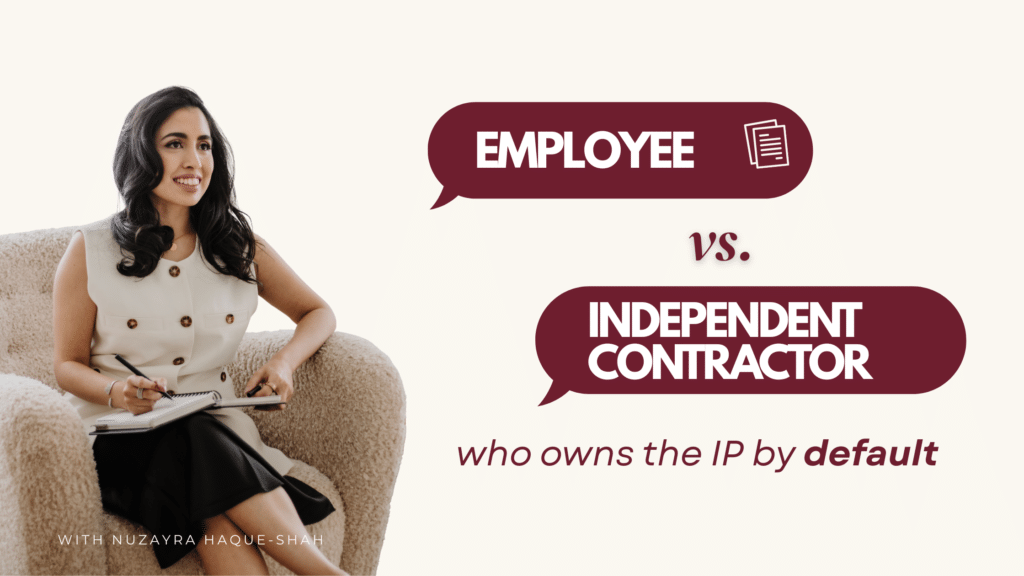
Who Owns the Work When You Hire a Contractor?
Nationwide brand protection for ambitious founders, direct-to-consumer innovators, and growing enterprises. Led directly by attorney Nuzayra Haque-Shah.
By default, the contractor does, not you. Copyright law gives ownership to whoever creates a work, and paying someone doesn’t automatically transfer that ownership. A “work made for hire” clause only works for nine narrow categories of work; almost everything a founder commissions, like logos, code, or website copy, falls outside them. You need a written assignment, not just a paid invoice, to actually own what you commissioned.
Why this Matters
Founders assume a paid invoice settles ownership. It usually doesn’t. The freelancer who designed your logo, or the developer who built your app, may still legally own the copyright, even though you paid the bill in full.
That gap tends to surface at the worst moments: due diligence during a raise turns up unclear IP ownership, a licensing deal falls through, or a former contractor reuses (or resells) work you thought was exclusively yours.
Fixing it after the fact means tracking someone down and asking them to sign over rights they may not want to give up, sometimes for a second payment on top of the first.
Doesn’t paying someone mean I own what they made?
No, not automatically. Copyright law starts from one default: whoever creates a work owns it, the moment it’s fixed in a tangible form. Hiring a contractor and paying an invoice doesn’t change that default. Ownership only shifts to you if a contract says so, in writing.
That’s the opposite of how it works with employees. Work an employee creates within the scope of their job automatically belongs to the employer, no separate paperwork needed. Independent contractors don’t get that automatic transfer, which is exactly why the employee-versus-contractor distinction matters for IP, not just for payroll.
What is a “work made for hire,” and does it cover my project?
A work-made-for-hire clause tries to make the commissioning business the legal author from the start, instead of transferring rights after the fact. For independent contractors, though, it only works for nine specific categories defined in the Copyright Act: a contribution to a collective work, part of a motion picture or audiovisual work, a translation, a supplementary work, a compilation, an instructional text, a test, test answer material, or an atlas.
Most of what founders commission, a logo, website code, brand copy, product photography, doesn’t fall into any of those nine. Put “work made for hire” in the contract for a logo design, and it can do nothing at all; courts have held that things like a standalone app or a novel don’t qualify no matter what the contract says.
So how do I actually own what I pay a contractor to create?
An assignment clause. That’s language stating the contractor transfers, assigns, and conveys all right, title, and interest in the work to you, in writing, signed by the contractor. That’s the piece that actually moves ownership when the work-made-for-hire doctrine doesn’t apply, which is most of the time.
Good contracts include both: a work-made-for-hire clause in case it does qualify, and an assignment as the backup that does the real work. Missing either one is a common, costly gap in template contracts pulled off the internet.
Does this work the same way for patents and trademarks?
No. There’s no work-made-for-hire doctrine for patents. An inventor owns their invention unless they’ve signed a separate patent assignment, regardless of who paid for the work. If a contractor invents something for you, you need an assignment covering that invention specifically, not just a copyright clause.
Trademarks work differently again: rights come from use in commerce, not from who designed the logo. But you still want a signed assignment for the artwork itself, or the designer could argue you never actually owned the graphic your mark is built on.
What if I already paid a contractor and never got this in writing?
Go back and get it signed now. A retroactive assignment, one the contractor signs after the fact, closes the gap going forward, though courts have been skeptical of relabeling something as “work made for hire” after the fact instead of using a plain assignment. An assignment, not a for-hire relabel, is the safer fix.
Most contractors will sign without friction, especially if the relationship is still active. The ones who won’t are usually the ones you needed the signature from most.
What to do next
1. Before work starts, get a written agreement that includes both a work-made-for-hire clause and a present-tense assignment of rights.
2. Name exactly what’s being created (code, copy, designs, photography) specifically in the contract, not just “the deliverables.”
3. Check any past contractor work you’re relying on now: your logo, website, or core product code. If there’s no signed agreement behind it, get one.
4. If a contractor built something core to your product, like proprietary code or a process, get a separate invention assignment for anything patentable.
5. Keep signed copies on file. Having the invoice is not the same as having the rights.
None of this is unusual to fix. It’s usually a short conversation and a signature, not a legal fight, if you catch it before you’re raising money or defending the brand. Book a consultation, and we’ll look at what you’ve already got, close the gaps, and build contracts that transfer ownership the first time.
Frequently Asked Questions
Does this apply to employees too?
Employees are different. Work created within the scope of employment is automatically owned by the employer, with no separate assignment needed. The gap discussed here is specific to independent contractors and freelancers.
What if my contract just says “all work product belongs to the company”?
That kind of broad language can work as an assignment if it’s clear, in writing, and signed, but vague phrasing invites disputes. Specific assignment language, naming the actual rights being transferred, holds up better than a general ownership statement.
Can a contractor use my logo or app in their own portfolio?
Can Only if your contract allows it. Without a license-back clause limiting it, a contractor who never assigned the copyright can technically reuse, license, or resell the same work elsewhere.
Is a verbal agreement enough?
No. Copyright assignments have to be in writing and signed to be valid. A verbal understanding, even a friendly one, won’t hold up if there’s ever a dispute.
What if the contractor is overseas?
U.S. copyright ownership rules generally still apply if the work is being used in the U.S., but international contracts add complexity around enforceability, so it’s worth having those reviewed specifically.
Do I need a new contract for every project with the same contractor?
Not necessarily. A master services agreement with a standing assignment clause can cover ongoing work, as long as it’s written broadly enough to capture future deliverables, not just the first project.
Related questions founders ask